At the gateway to La Mauricie National Park, on the quiet shores of Lake Bellemare, a small village of 1,500 souls is home to one of the most talked-about tables in Québec right now. Auberge Saint-Mathieu, freshly awarded a Michelin star.
It all began in the 1990s, when Louise and Jean-Marcel bought a cottage and a plot of land on the shore of Lake Bellemare with the idea of turning it into a bed and breakfast. The project quickly grew into a ten-room inn with a restaurant, which for over twenty-five years welcomed a mostly European clientele drawn to the wide-open spaces of Parc de la Mauricie. When Louise and Jean-Marcel began thinking about retirement, their son Nicholas Trottier-Lacourse and his childhood friend Samy Benabed offered to take over the business. After two summers testing the formula, the two friends made the transition official, joined by Étienne Prud’homme (who had worked the floor at Garde-Manger, Liverpool House, and Pastel in Montreal before opening cocktail bars in Australia and New Zealand) and by Florent Borrel, a Frenchman who fell in love with the place during a 2022 stay to the point of becoming a co-owner. In May 2023, Auberge Saint-Mathieu reopened in a tighter, more focused version, truer to this new generation.
Since then, the accolades have piled up: a Michelin Green Star in 2025 for its sustainability efforts, followed by a Michelin star proper and the Michelin Young Chef Award in 2026 for Samy Benabed, making the inn the most decorated restaurant in that year’s Québec Guide selection.
Samy Benabed was born in 1992 in Trois-Rivières to Moroccan parents. His father, a caterer by trade, also drove deliveries for a local rotisserie chicken chain, and young Samy was already spending his summers in the family kitchens from the age of 16. He tried the Institut de tourisme et d’hôtellerie du Québec but dropped out after a single session, disillusioned by teaching that felt too classical and left him with the sense of unlearning what he already knew. His real education happened on the job, in Montreal’s top kitchens, where he honed his butchery skills, before two formative stages at the Relæ restaurant in Copenhagen. Back in Québec, chef Laurent Godbout put him in charge of the kitchens at L’Épicier, in Old Montreal. Then, in 2020, it was on to Mauricie and Auberge Saint-Mathieu, where his home region and his family were still waiting for him.
The restaurant offers an eight-course tasting menu that changes with every season, following what’s foraged and what comes in. Vegetables from Mauricie farms within roughly a 100-kilometre radius, fish and shellfish from Gaspésie and the Îles-de-la-Madeleine. It can be paired with a wine pairing put together by Étienne and sommelier Alexandre Gagnon (formerly of Montréal Plaza and Hoogan & Beaufort), or with a fully non-alcoholic pairing. A fair price for a starred restaurant, at around $130 CAD. I’ll be pairing my meal with the non-alcoholic option for a $65 CAD supplement.
My Experience at Auberge Saint-Mathieu
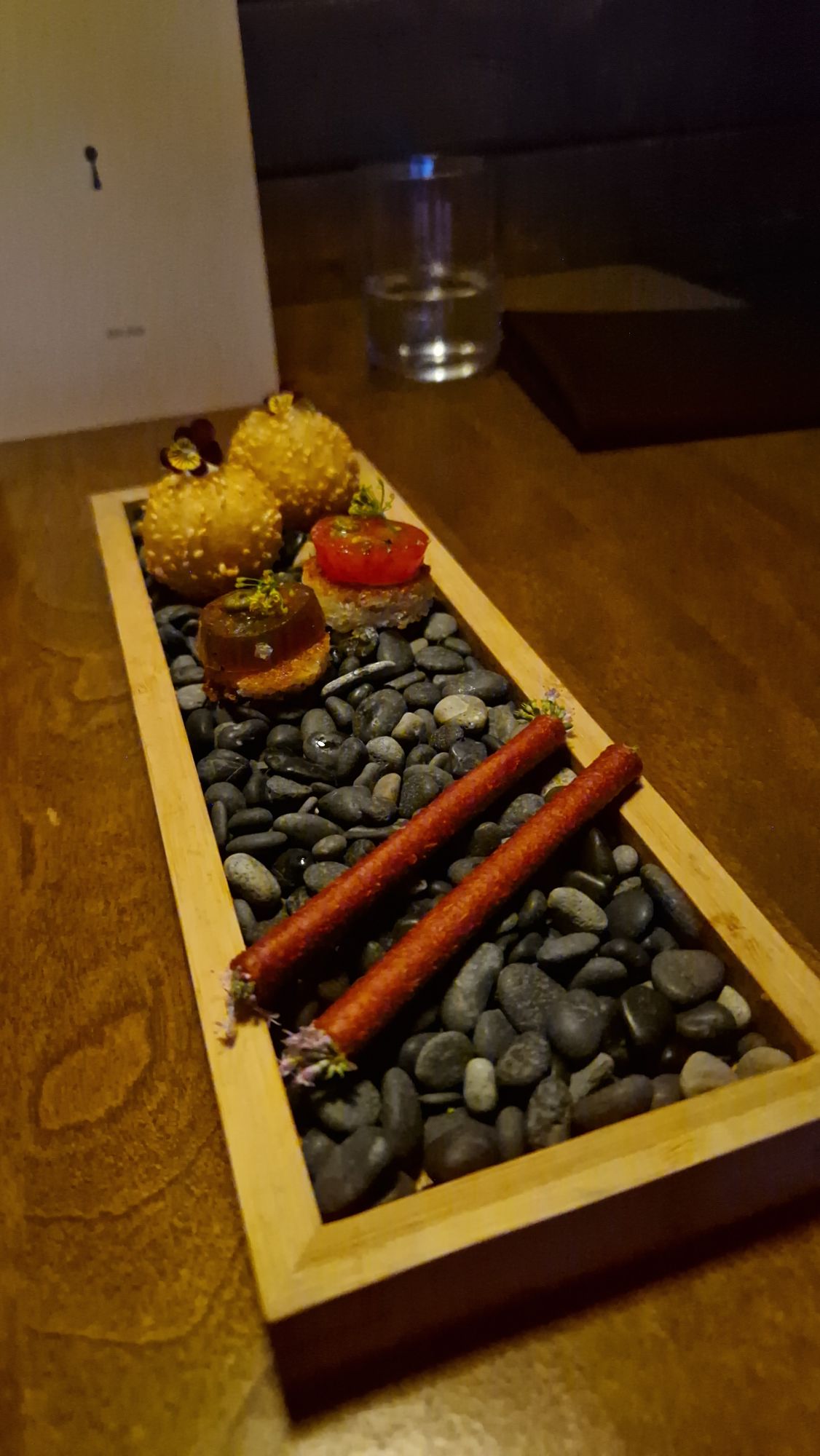
The meal opens with a playful little bite: a cigar of dried tomato, stuffed with tuna, topped with a thyme flower. Beautifully balanced right from the start, the almost-sweet richness of the dried tomato wraps around the tuna without ever overpowering it. Next comes a milk bread roll, crisp, coated in a tomato mayonnaise. The kind of bite you’d assume is unremarkable, and yet it lingers on the palate well after the last crumb. The tomato stays quiet but persistent, carried by a generous, well-whipped mayonnaise. Then a cheese croquette, rolled in sesame. The toasted seed brings the umami that this kind of otherwise excellent bite sometimes lacks.
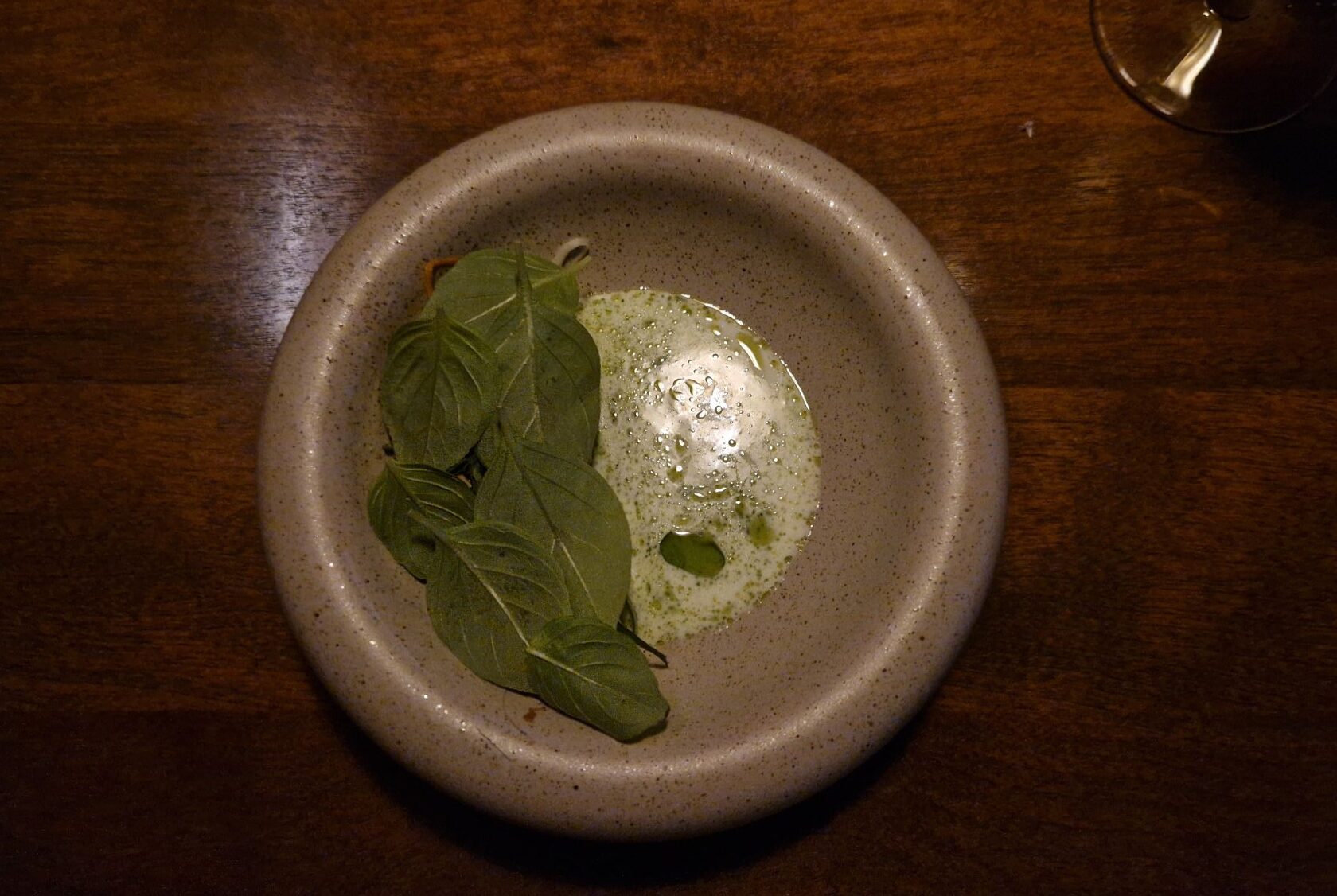
The next course, dubbed “Le Jardin” and paired with a melon juice, is a small tour de force. Julienned vegetables from the farm down the road: radish, celery, and others I wish I could have named every one of, sit beneath Thai basil, sunflower seeds, and coriander. A peanut butter adds body, while a green chive oil, almost creamy, ties everything together. What you end up with looks a lot like a Vietnamese salad, bursting with freshness, but built entirely from local products.
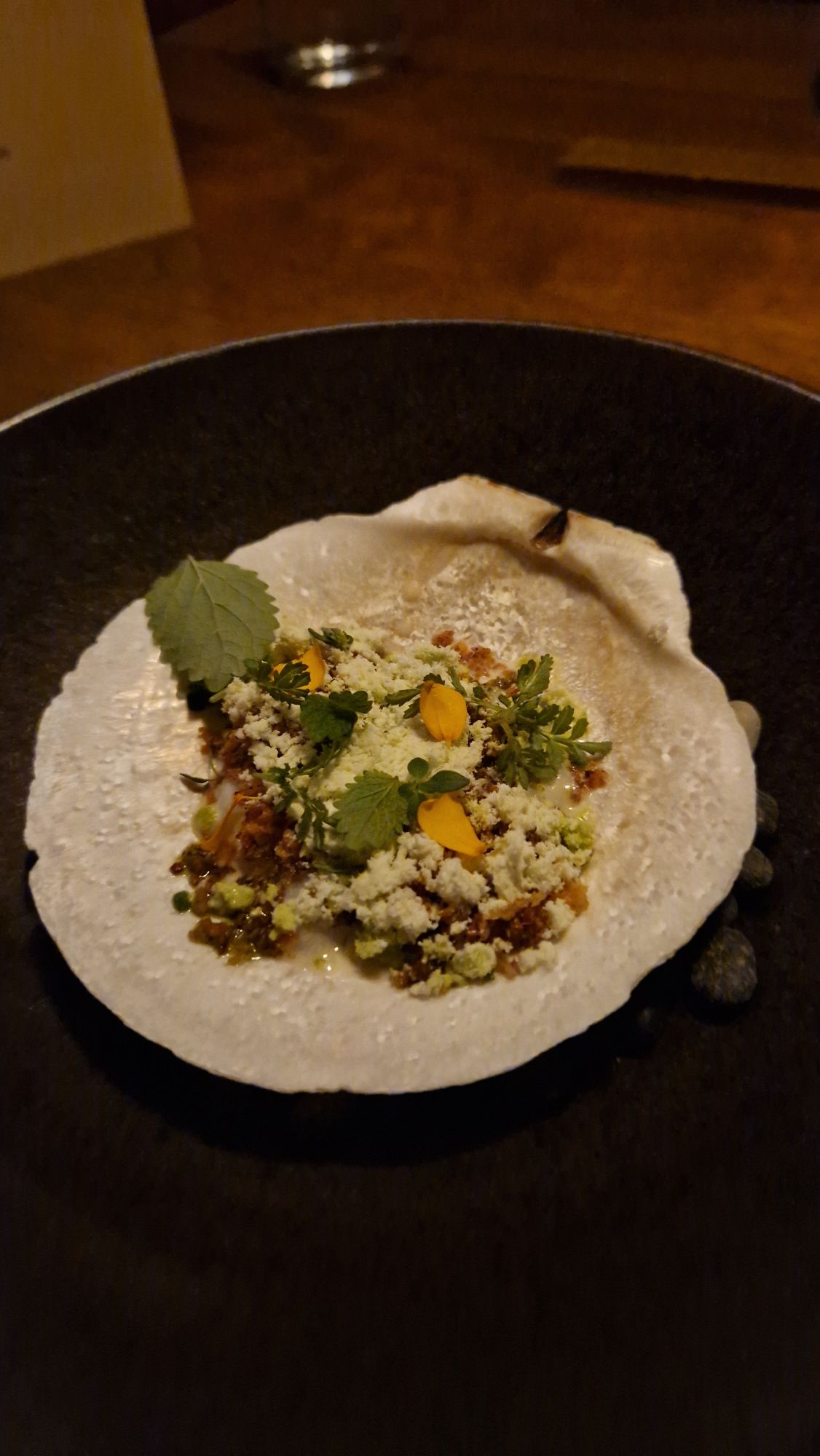
Then comes a course built around fermentation: Îles-de-la-Madeleine scallops in an awakaze jus (a fermented rice juice, almost like sake but without the alcohol). The scallops, bright with yuzu, are carried by a fermented chili. Small crisp bits of panko break up the scallop’s silky texture, with pressed tapioca sprinkled on top, then lemon balm, verbena, and lemon thyme for freshness. A vivid, tangy dish.
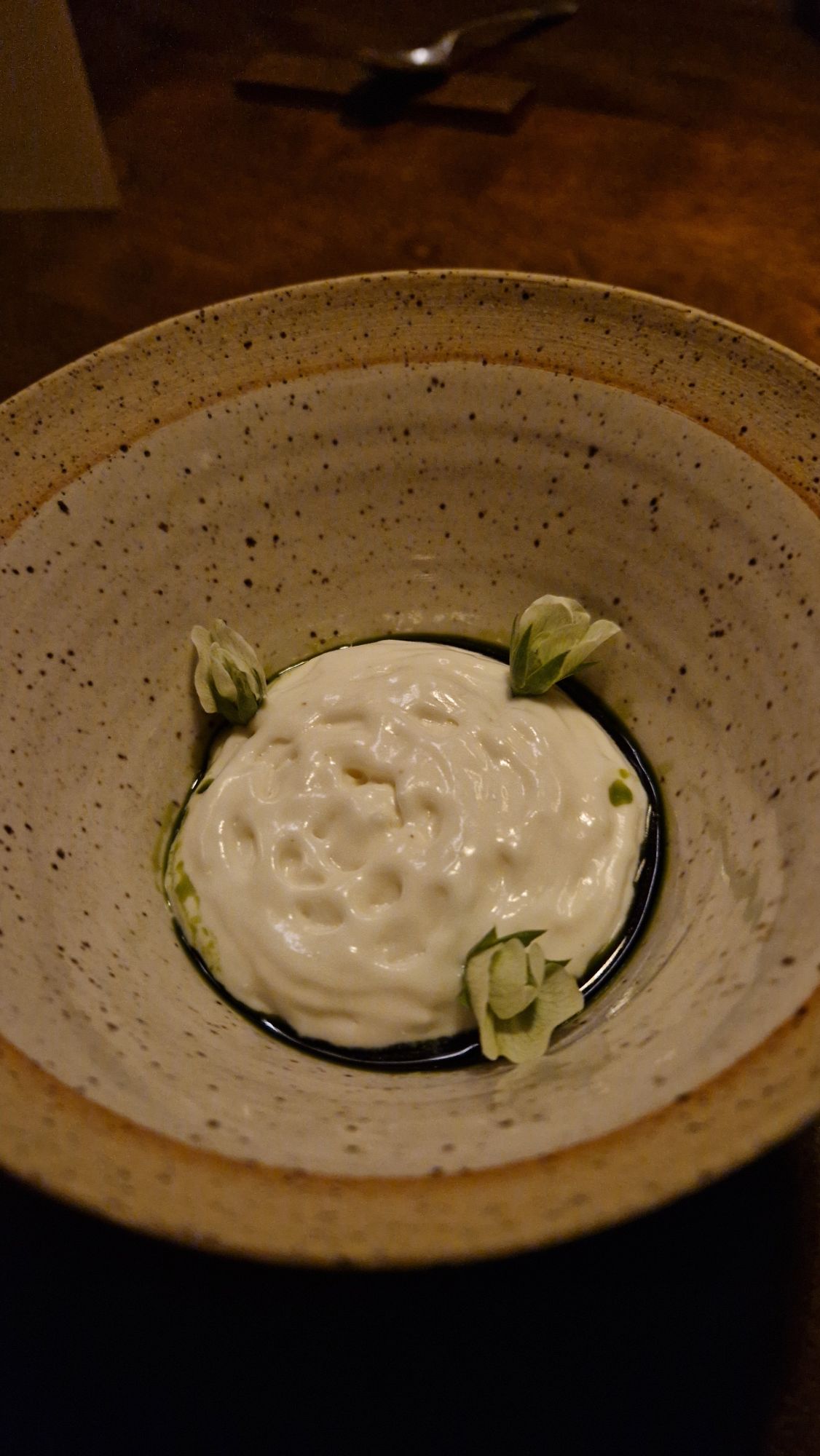
The steamed smoked pea course, served with white ham, is arguably the most accomplished of the evening in terms of balance and my favourite. An ajo blanco espuma (garlic, bread, almond) crowns the dish, with a thread of lovage oil. But it’s the small sour soup hidden at the bottom of the plate that makes the dish so beautiful, countering the lightness of the espuma with almost laser-like precision.
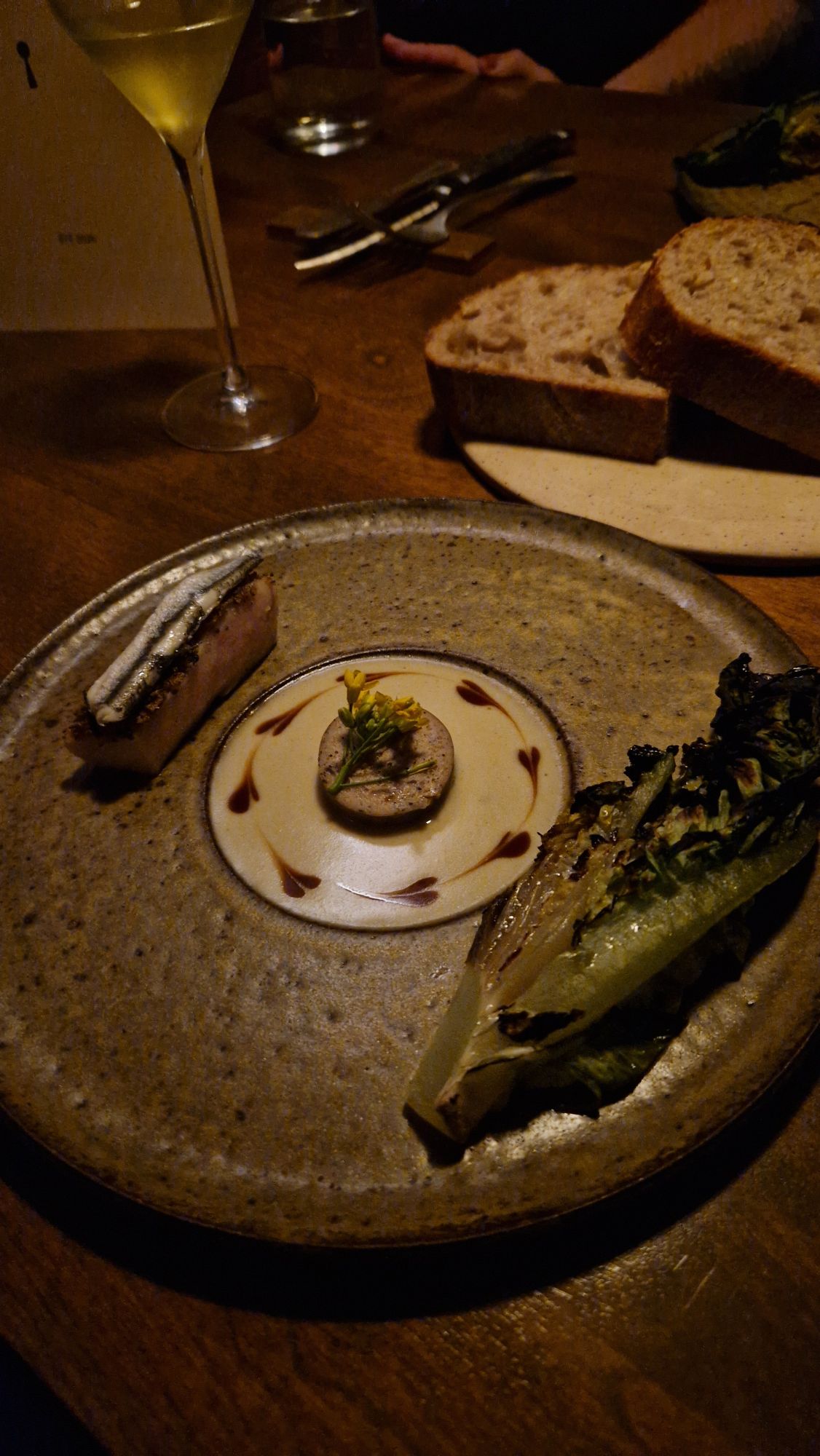
What follows is a bold reinterpretation of the Caesar salad. A “chaperon,” where a grilled anchovy is layered on top, is served with white pudding (boudin blanc) dipped in a sauce cut through with a touch of mustard, and grilled broccoli florets standing in for the lettuce leaf. The whole thing comes with good sourdough bread for sopping up the sauce, plus a honey coulant melted into butter. The white pudding — which you wouldn’t expect in a dish with Caesar-salad accents, the one small letdown — nonetheless fits in surprisingly well and is a genuinely high-quality product, one you almost wish had a bigger role, or a dish entirely of its own.
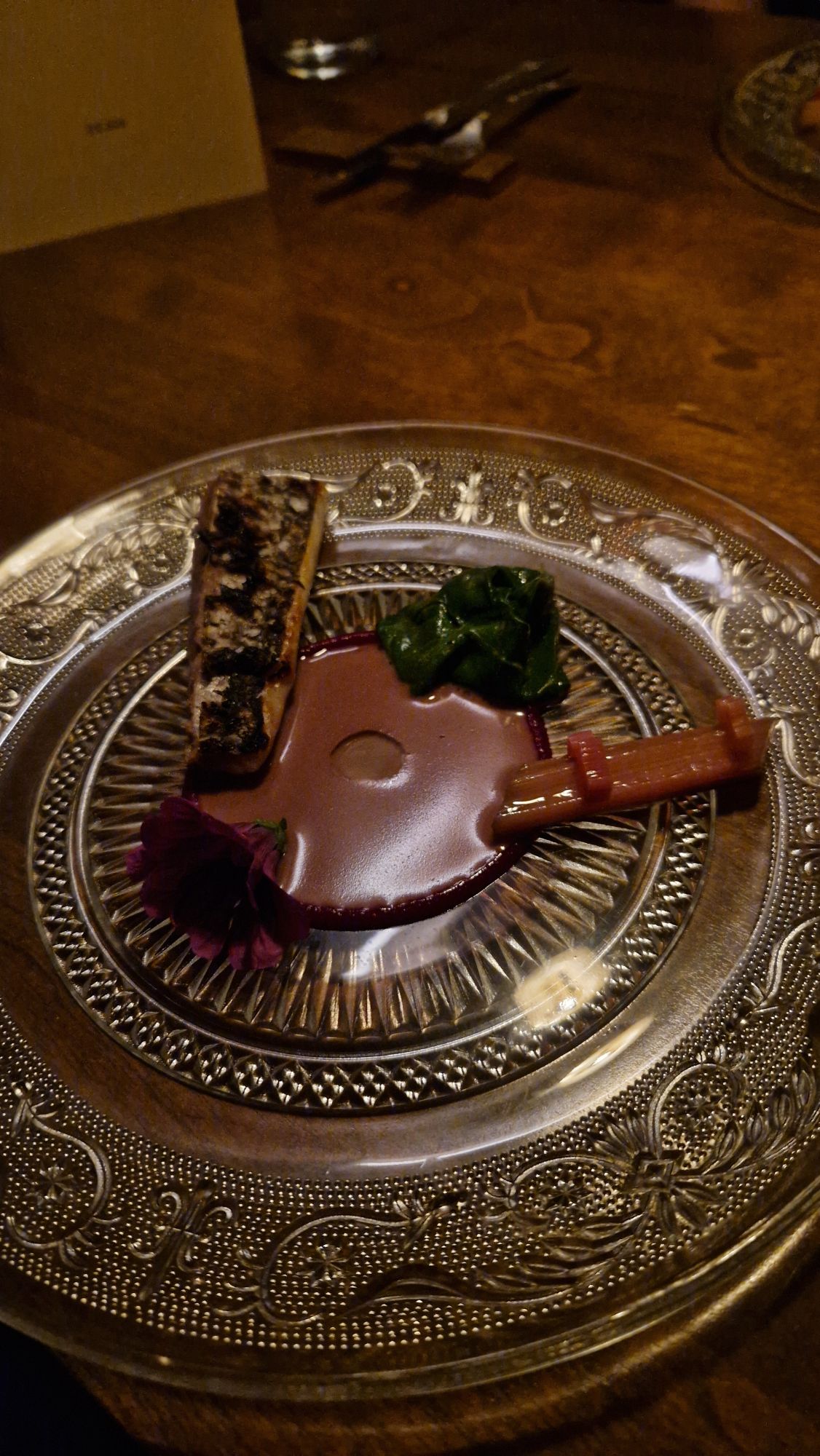
Then comes the striped bass, cooked over charcoal, served with beet and a red wine sauce, and this is where the meal stumbles a little. The cooking is pushed one notch too far, and the fish gives off a smell that’s too grilled, verging on burnt and almost bitter. Thankfully, the red wine sauce softens the blow and just barely saves the dish.
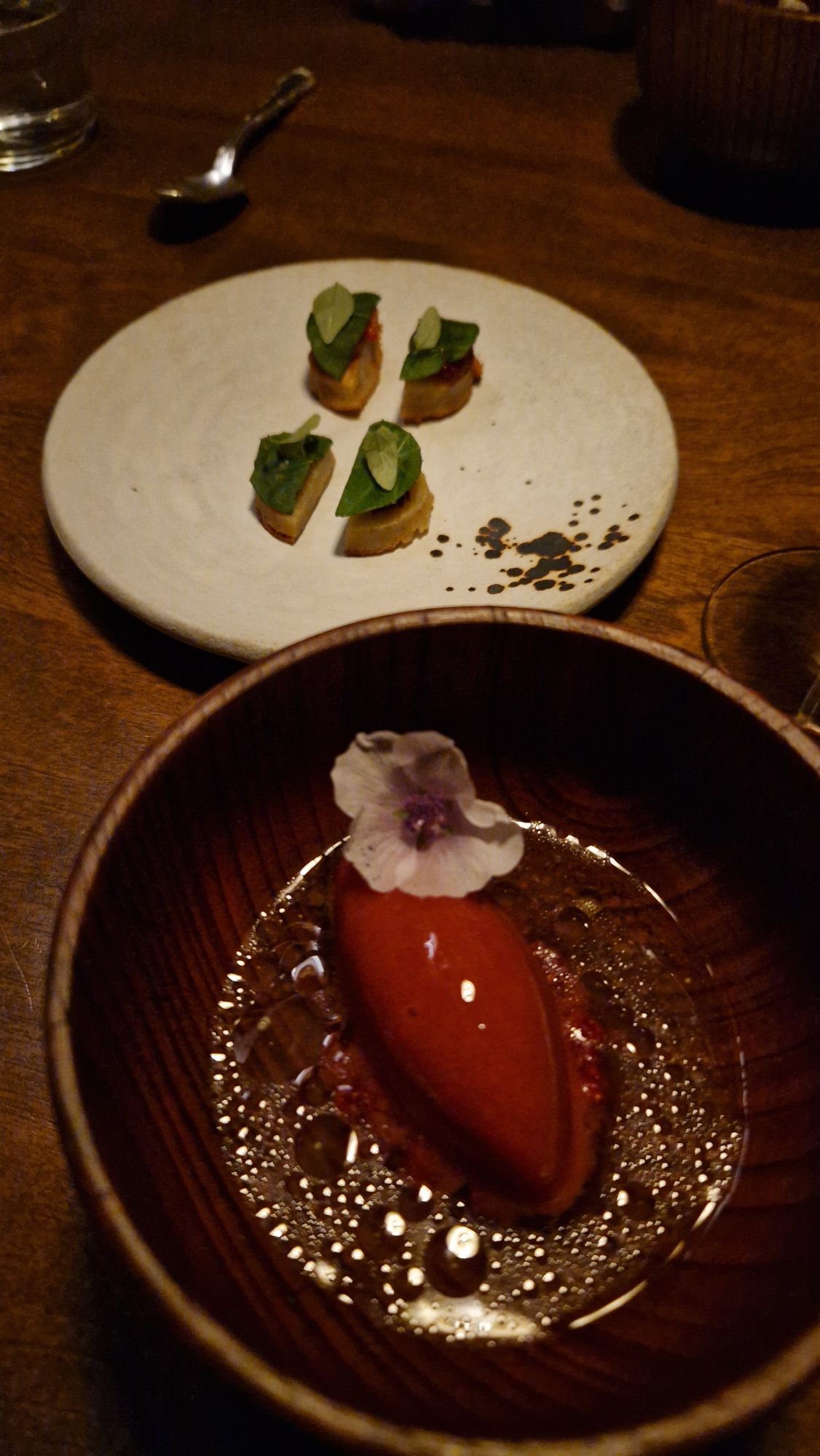
The tomato-strawberry pre-dessert plays the surprise card. Tomato water paired with a strawberry sorbet, then, off to the side, a small mystery bite where you have to guess whether it’s dried tomato or dried strawberry. It’s a fun little game, since both versions are so subtle that they become almost indistinguishable from one another. A nice bit of palate trickery.
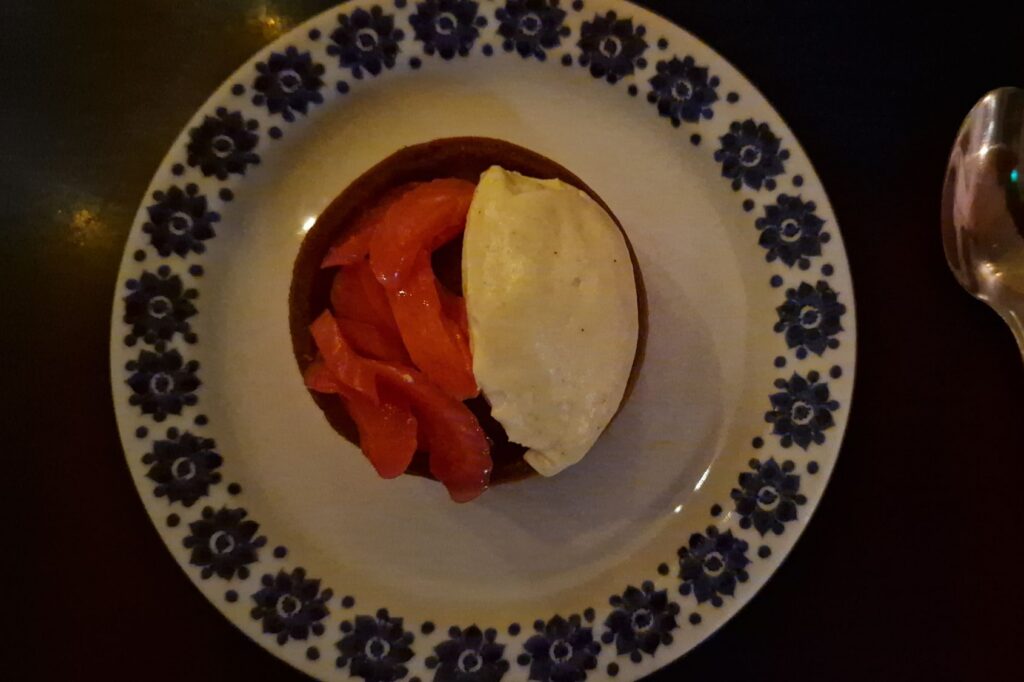
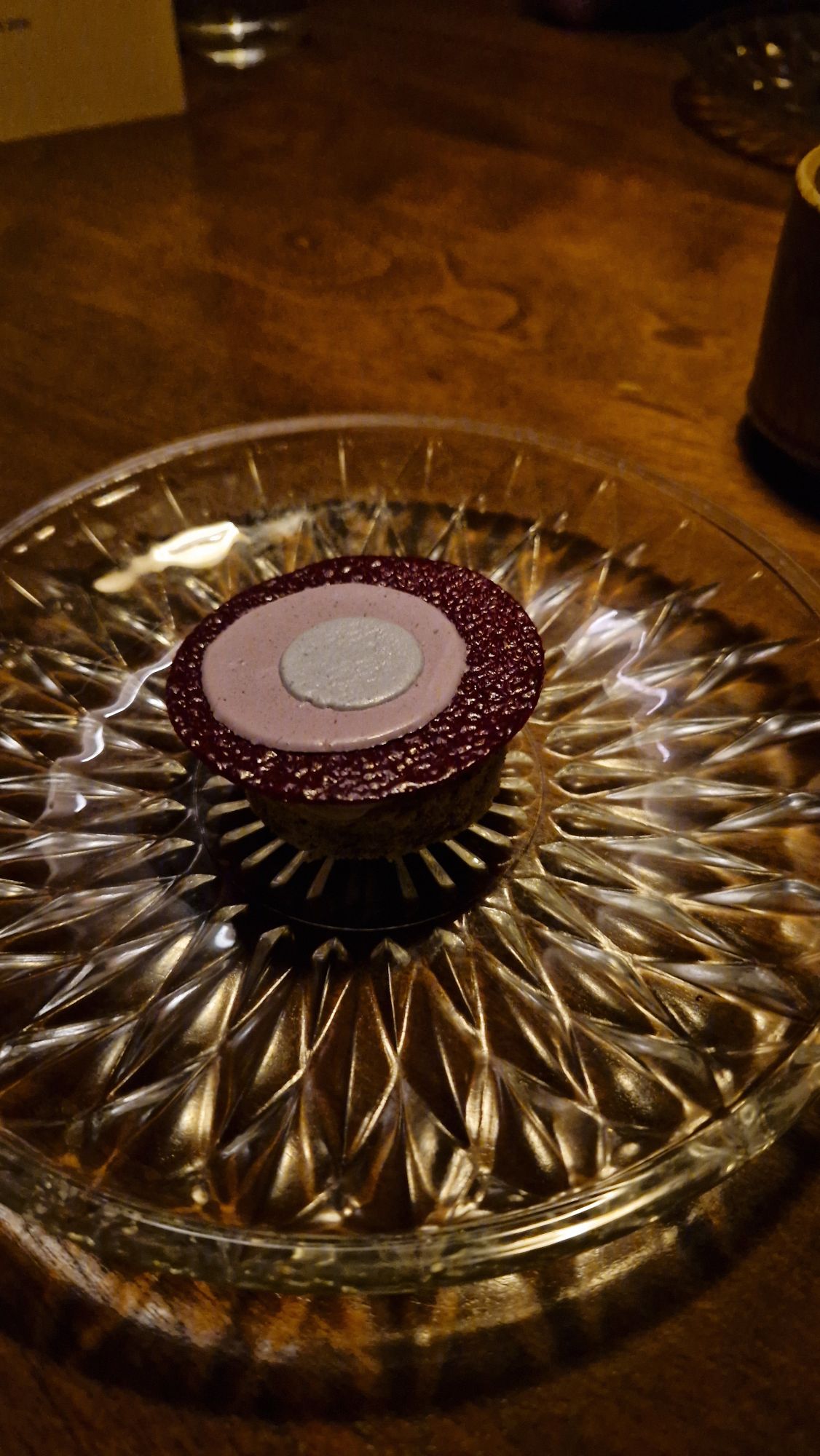
Finally, the meal closes on a blueberry with its honeyberry (camerise) tuile, carried by a sponge-cake style base that traps the fruit almost like a molten centre. The bitterness is bold and unmistakable, but it’s a lovely gesture to close the meal, right to the end, with local products.